Film Editing Explained: How Cuts Shape Story and Pace
BY: DA PUBLISHED: 2026-11-24 20:59:03 | UPDATED: 2026-11-25 08:11:50 | Views: 75
Learn how film editing works, from cuts and pacing to continuity and transitions, with simple tips to notice editing on your next movie night.
Most of us watch a film and remember the story, the acting and the music. Very few of us notice the editing, and that is exactly how editors want it. When editing works well, it feels invisible, yet it decides what you see, for how long, and in what order.
This guide explains film editing in plain language. You will learn the main types of cuts, how pacing creates feeling, and how to spot editing choices on your next movie night. It is spoiler-free and does not discuss any specific film.
Key takeaways
- Editing is the craft of selecting, ordering and timing shots to tell a story.
- A cut is a choice about where your attention goes next.
- Pacing (how long shots last) shapes tension, calm and energy.
- Continuity editing keeps time and space clear so you never feel lost.
- Transitions such as fades and dissolves signal changes in time or mood.
- You can train your eye to notice editing with a few simple viewing habits.
What Film Editing Actually Does
A film is shot in pieces. Scenes are filmed from several angles, often out of story order, and many takes are recorded. The editor reviews all this material and builds the final film from it.
Editing is much more than trimming. It decides which performance take feels most natural, which angle reveals the right detail, and when a moment should breathe. The same footage can feel funny, tense or tender depending on how it is put together.
Many editors describe the job as shaping time. A conversation that took an hour to film might last two minutes on screen, and a single second of emotion might be stretched so you feel it fully.
The Main Types of Cuts
A cut is the moment one shot ends and another begins. Different cuts do different jobs, and learning a few names makes it easier to talk about what you see.
| Type of cut | What it does | Typical feeling |
|---|---|---|
| Standard cut | Moves directly from one shot to the next | Clear and natural |
| Match cut | Links two shots through a similar shape, movement or idea | Smooth, clever, thoughtful |
| Jump cut | Skips a small piece of time within the same view | Energetic, restless, modern |
| Cross-cutting | Alternates between two or more places happening at once | Suspense, connection |
| Cutaway | Briefly shows something related, then returns | Adds detail or context |
| J-cut and L-cut | Sound from the next scene begins early, or the old sound lingers | Flowing, natural |
No single cut is better than the others. Each is a tool, and good editors choose the one that fits the moment.
Pacing and Rhythm: Why Some Scenes Feel Fast
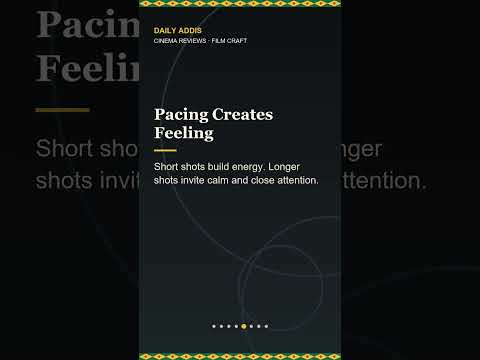
Pacing is the speed at which a film moves. It comes mostly from shot length. Many short shots in quick succession create urgency and excitement, while long, steady shots invite you to settle in and observe.
Rhythm matters as much as speed. A film that is fast all the way through can feel tiring, and one that is slow all the way through can lose attention. Editors often vary the tempo so a quiet moment makes the next lively one feel stronger.
Pacing also connects to other elements. Music, dialogue and movement within the frame all influence when a cut feels right. Many editors cut on a natural pause, a glance or an action, because it feels smooth to the viewer.
Continuity: Keeping the Story Clear
Continuity editing is the set of habits that helps audiences follow a scene without confusion. It keeps the sense of time and place steady even when many shots are joined together.
Video 1 of 1
A few common ideas appear again and again:
- Establishing shot: a wide view that shows where the scene happens.
- Eyeline match: a character looks off-screen, then we see what they are looking at.
- Screen direction: people and objects keep moving in the same direction across cuts, so we stay oriented.
- Cutting on action: the cut happens during a movement, such as opening a door, which hides the join.
Sometimes filmmakers break these habits on purpose to create confusion, dreaminess or surprise. Knowing the usual rules helps you notice when a film plays with them.
Transitions: Fades, Dissolves and More
Not every shot change is a hard cut. Transitions soften or mark a shift, and they are used with care.
- Fade in or out: the image gradually appears from, or disappears into, black. It often suggests a beginning, an ending or a pause.
- Dissolve: one image gently blends into another, often hinting at time passing.
- Wipe: one image pushes another off the screen. It can feel playful or stylized.
Most modern films use plain cuts for the majority of scenes. Transitions are kept for moments when the filmmakers want to say something about time or mood.
How to Notice Editing While You Watch
You do not need special equipment to appreciate editing. A few small habits will sharpen your eye without spoiling your enjoyment.
- Watch a conversation twice in your mind. Ask why the film shows one speaker instead of the other at a given moment.
- Feel the tempo. Notice when scenes speed up or slow down, and what you feel as a result.
- Listen for sound bridges. Does a sound arrive before its picture, or stay after it leaves?
- Spot the transitions. Notice how the film moves between places and times.
- Count a shot. Pick a scene and silently count how long each shot lasts. The pattern often surprises people.
When writing a review, you can mention editing in simple terms, such as whether the pacing supported the story or whether scene changes were easy to follow. Describe the effect rather than revealing what happens.
Frequently Asked Questions
What does a film editor do?
A film editor selects the best material from everything that was filmed and arranges it into the final story. They work on pacing, clarity, performance and emotional flow, usually in close conversation with the director.
Is editing the same as visual effects?
No. Editing decides which shots appear and in what order. Visual effects create or alter images within a shot. The two crafts often work together, but they are separate jobs.
Why do some films feel too long or too rushed?
Often it comes down to pacing. If scenes repeat information or linger without purpose, a film can feel long. If important moments get too little time, it can feel rushed. Viewers also differ in what pace they enjoy.
Can I learn basic editing at home?
Yes. Many free and beginner-friendly video editing apps exist for phones and computers. Try cutting a short clip of family moments, and experiment with shot length to see how it changes the mood.
Conclusion
Editing is the quiet craft that holds a film together. It shapes pace, guides your attention and makes sure the story is clear and moving.
On your next movie night, try watching one scene with an editor's eye. Once you start noticing the cuts, you may find a new layer of enjoyment in the films you love.
You May Also Like
Super Girl Movie 2026 is finally here!
4 months agoLatest Videos
Stop Buying Apartments Blindly: 3 Hidden...
Jul 08, 2026Super Girl Movie 2026 is finally here!
Jul 05, 2026Ethiopian Kitfo
Jul 05, 2026Related Articles
Camera Shots and Angles Explained: A Beg...
2 weeks ago
How to Write a Movie Review: A Simple Sp...
3 weeks ago